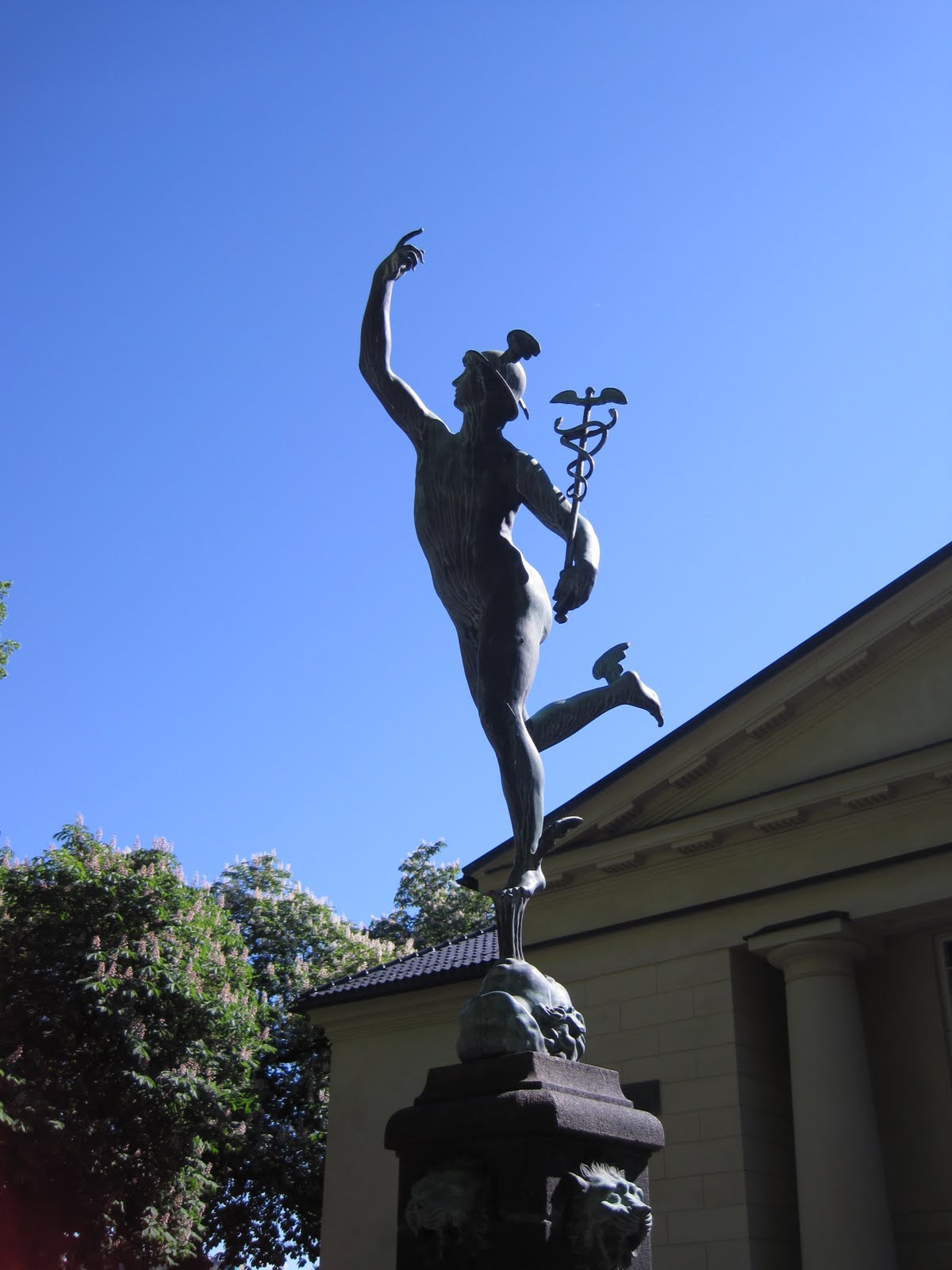
 As mentioned, Hermes was the god of communication, theft, magic and commerce, of which the latter is the most important reason we find his countenance on buildings all over the world. As a god of commerce he is an excellent symbol for the stock exchange, and he is indeed placed on a pidestal outside Oslo Stock Exchange, pointing upwards for eternal growth. It's very common depiction of Hermes. Why he is firmly placed on a breath of air emerging from someone's decapitated head is beyond me. Admittedly I'm not as well versed in Greek myth as I'd like to be. If anyone has a clue, let me know. There is another Hermes on the other side of the building, and it's also worth a mention, though I couldn't be bothered including a picture of it here.
 As a god of commerce he also adorns Christiania Glasmagasin, one of the most well know and early department stores in Norway. Christiania Glasmagasin, despite its name and upper class appeal is a shopping mall, and I doubt many of the people who do their shopping there notice Hermes above the door main entrance where he looks absentmindedly across the street where Christian IV points decisively at the ground. If I had to rest above the entrance to a shopping mall I'd probably want to avert my gaze from the vulgarians below me too. It's a really beautiful bust though. (There is such as thing as an unattractive bust dear reader...)
 OK, so shopping malls I can understand. In the provincial village Trondheim there is even a mall named after him: Mercursenteret. Mercury of course being the roman name for Hermes. The next one is a mystery though. Smuget is a restaurant/bar/stage in Oslo well known for its stand up shows and various events, and for some reason they have a huge full statue of Hermes resting above the main gate, next to Poseidon. I have no idea what they're doing there, and it's not like they're subtle in any way. I can only guess whatever institution was there before Smuget had some link to commerce and shipping, but I don't know. Not gonna be bothered trying to find out either. It certainly is one of my favorite depictions of him however.
 This leads to the next one, which is just a block or two away from the stock exchange. It's a more subtle ornament than the former three, and I have no idea what it's doing on that particular building - which houses a military academy. Hermes was a god of many things, but invasion, murder and anguish were not among his attributes. The building is located in an area of the with quite a bit of history, and it's not unlikely that there was some kind of trade house or something there at some point. After Oslo burned in 1624 the town was moved here by the danish king and renamed Christiania in honor of himself (this is also the reason for the aforementioned statuary pointing to the ground). In every other respect it's a rather unassuming building, but any building with a Hermes on it is close to my heart.
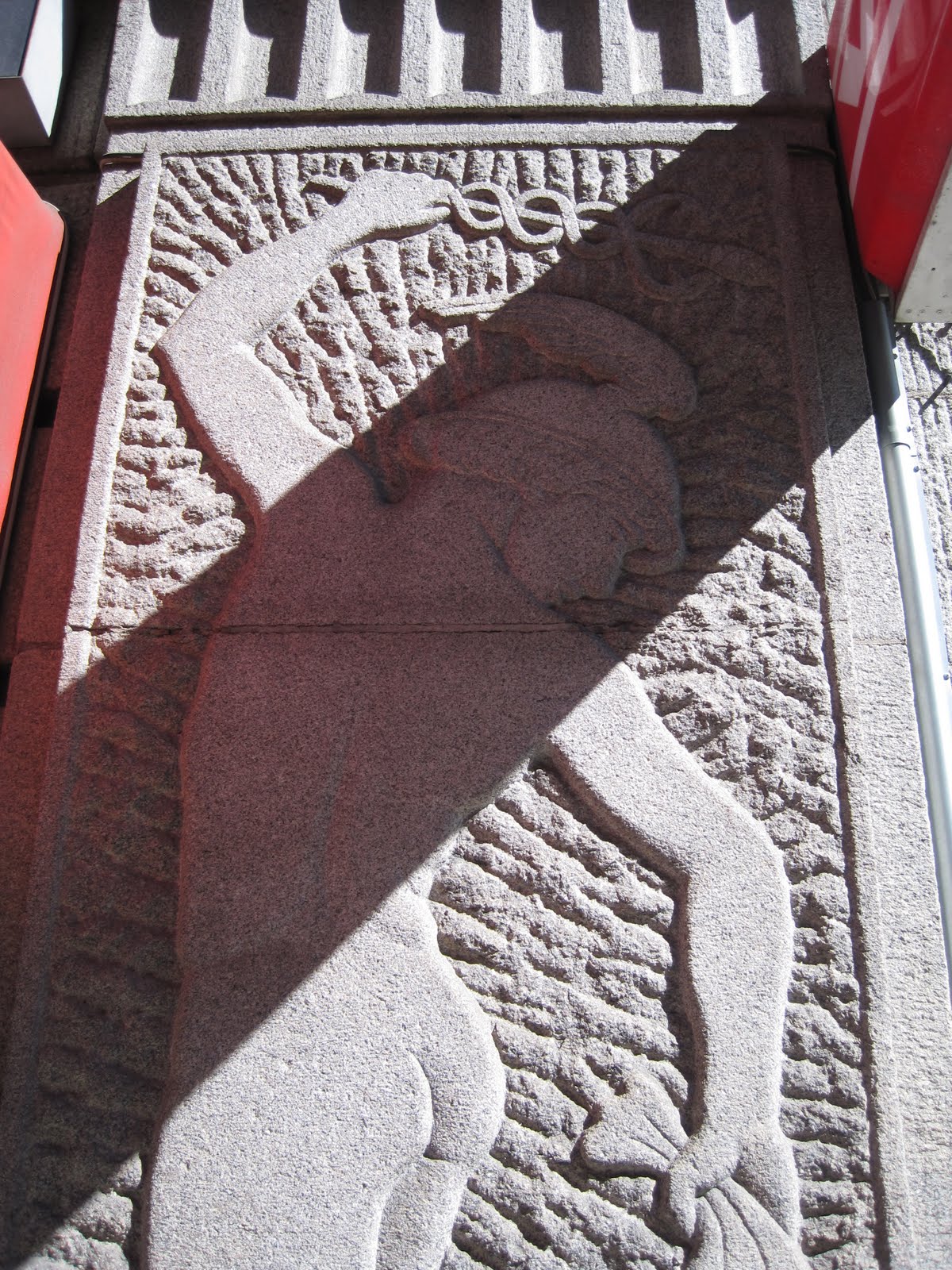 Not far from this one there is another one, in Fred Olsens gate. It's a more modern depiction, but I don't know how new, could look like the twenties or thirties judging by style. I would guess Art Noveau anyway, I'm not an expert. This one was brought to my attention by a friend of mine who also has interests in the world of occultism. I don't have much to say about this one,except that it's really nice, and that it's just one of many really cool ornaments on this particular building. Some of them even look overtly occult. Such as the child holding a winged globe just to the left of the Hermes. Incidentally the bulding also houses an outlet of the scammers in UFF, where you should never spend money if have any form of conscience whatsoever. And, yes, the sun was out the day I took the picture, and my camera isn't exactly state of the art. That shadow annoyed the hell out of me.
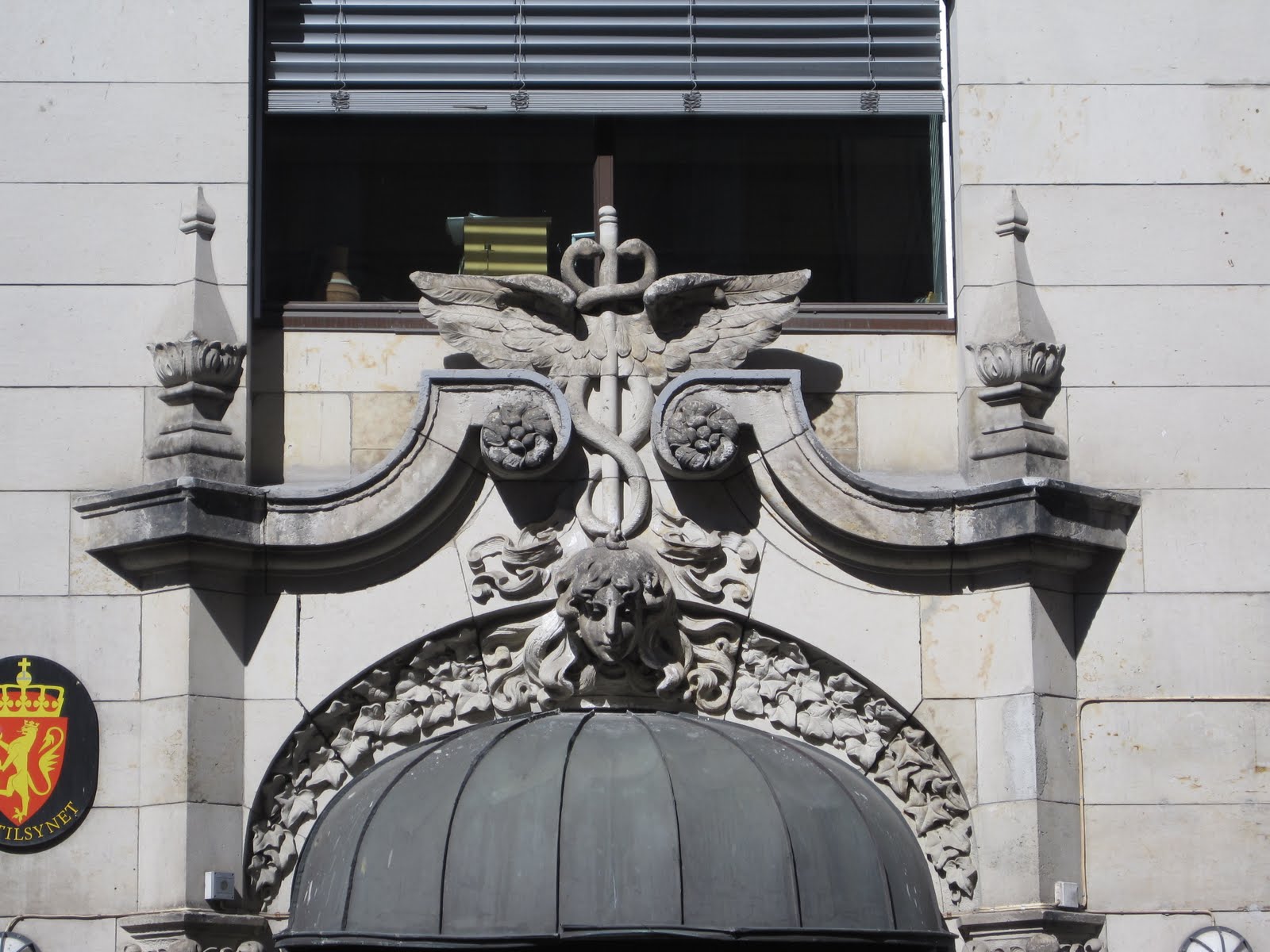 Now for the caduceus, the snake staff Hermes often carries. For some reason it has become a symbol of pharmacies and medicine, and can often be seen on medical buildings, such as hospitals and drug stores. Most likely this is due to a misinterpretation of the symbol as a variation of the other snake staff, the rod of Asclepius, which is actually relevant to the medical profession as opposed to the caduceus. I'm not going to say much about this quite common symbol, because a list of pharmacies would be tedious - and would further this rather strange misapproproation. The Caduceus is not just a symbol for Hermes of course, but it's probably been more associated with him than the other greek gods over the years, and I don't think it's an oversight to say that in most cases (except of course in the medical ones) it's safe to assume that the staff represents Hermes. This first one is located just across the street, more or less, from the military academy and housese Datatilsynet, a public institution responsible for monitoring the use of surveillance and data storage and so forth. So the Hermes reference is certainly apt, though I do suspect that this building is much older than the institution it houses.
 A case where the caduceus is clearly linked to Hermes is on the aforementioned Christiania Glasmagasin, where there are in fact several of them. They're not very big, but you can clearly make them out near the western entrance. Neither is it as conspicuous, but there is certainly no doubt as to what it is.
So anyway, that's it for Hermes. I'm sure you should be able to spot a few of these on your own, and I haven't covered all the ones in Oslo either. They are quite numerous, and if you live in a city of reasonable size, and with a little history I'll bet money there's atleast one Hermes there. Keep your eyes peeled and your camera charged.