20100801

Privatized Propaganda

My political view are well known to anyone who's frequented this blog, or otherwise been subjected to my opinions. They're not really the subject of this blog however, I just wanted to tone an ever so little black flag before I get started on my subject: privatized propaganda warfare.

Over the last year or so wikileaks has become the most publicized actor in an ongoing information war between peace activists and various governments of the world. Wikileaks ofcourse has been responsible for leaking a great deal of classified material pertaining to the wars in Afghanistan and Iraq, and this upsets the people responsible for sending troops to this wars.
Wikileaks however is not the only opposing actor in this war against government information monopolization and spin doctoring, and the war is not new.

I have previously posted the cultural terrorist manifesto, as well as a video by Emergency Broadcast Network - and both of these posts concern the same ongoing information war. What EBN, the Grey Wolves and Wikileaks have in common is that they represent a phenomema or ideology often dubbed infoanarchism. An ideology they also share with the swedish Pirate Party and several other groups and individuals - including yours truly. The main motto for this loose movement of people is "information wants to be free". If you're into revolutionary romanticism we can call this an "information guerilla". It's a quite accurate description.

In other words it as an ongoing insurrectionist campaign being waged between state forces and comercial media with huge budgets and established channels of communication and technology on one hand, and volunteers with highl improvised means of communication and distribution on the other. In many ways this is an example of assymetric warfare, or fourth generation warfare, but on the information front rather than on the classic battlefield.

Assymetric warfare is seen by many as the most important tendency in modern conflict and it is usually typified by regular military units with training and technology going against a guerilla with little or no training and little common ground with their enemy. Usually wars are fought over territory or ideology, or both, whereas an information war is waged in the field of public image and credibility and over a strictly ideological goal.

The interesting thing is however what history teaches us about what happens when a large military system takes on a guerilla. Quite often the "weaker" party succedes, and the government must accede to loss. Whether we are talking about conflict of force, in the cases of the american revolution, the vietnam war or Gandhi's campaing to oust the brits from India - or we are talking about popular protest movements such as the civil rights movement in the sixties. To retain some shred of legitimacy a government cannot trample the rights of its citizens lest it become a dictatorship. So this wikileaks bout is something of a pickle for the authorities. They must attack the activists while trying to come out as the party that takes care of the public interest. Wikileaks must be made out to look like they are thugs, criminals, sociopaths and evildoers, rather than concerned citizens. Once people start questioning why the government so often feels the need to take on their own citizens, whose will they supposedly draw their legitimacy from, the authorities are quite simply fucked...

I'll leave you to draw your own conclusions, maybe while you check out this wonderful little rap about wikileaks.

20100728

Wikileaks, the falcon and the snowman.

This week Wikileaks has released approximately 90,000 classified documents garnered from sources within the massive US defence. Pentagon and the White House are consequently angered to the point of bursting like lemmings, and have naturally initiated a search for the "traitor" in their midst. However, it seems that several thousand employees had access to these particular documents, and the search for the culprit may not be as easy as it is to find the un-american in "24". It is going to take time, and it's going to involve quite a few people.

This of course leads my mind to american intelligence in general. Of course the expression itself became an oxymoron with the invasion of Iraq because of their quite laughable work, but organizations like CIA, NSA, SS (secret service in case you didn't know) and the FBI have a long history of fuck ups. During the cold war their ranks were so littered with sleepers and walk ins that it's not much of an oversight to say that they lost the intelligence war against the Soviet Union. This history of incompetence goes back even further, to the days of OSS (office of strategic services), who were so easily spotted while under cover that the joke was that OSS was an acronym for Oh, So Social. Despite their efforts to make you think otherwise, the american intelligence agencies really are laughable compared to their counterparts in other countries.

This history of incompetence makes me think of one of Sean Penn's early films, the Falcon and the Snowman. Usually on film the CIA and similar organizations are portrayed as labyrinthine conspiratorial agencies full of hardcore toughies with the latest in technology, death squads and intelligence gathering gadgets. Whether they are up against innocent civilians in the ridiculous Enemy of the State or even the slightly more realistic Three Days for Condor Condor, or they are defending freedom against horrible soviets in ... Errr... I don't think I've ever seen a film where the CIA are the good guys except for comedies or James Bond. Even good ol' boys in the US prefer to see their very own CIA as the enemy. And it's no wonder. You don't want these people on your side. Just look at their work in Chile back in 1973. In the real world espionage isn't quite so sci fi-ish or fancy, and their agents are hardly as kewl as in the movies. (True, the do have technological monsters like Echelon in their service, but the CIA still can't catch Bin Laden. Not that it would matter much if they did. People are pissed off at the US for a reason. Bin Laden isn't Cobra Commander you know...)

The Falcon and the Snowman is a film about a pair of walk in spies (played by Sean Penn and Timothy Hutton) and their follies as they hand over documents to the KGB in exchange for monetary attention. While most films involving espionage of some sort feel the urge to include gun fights and explosions, and the occasional cleavage, this film is quite realistic. Intelligence work is mostly analysis and catalogueing documents. Very few of the people involved with intelligence work go to embassies and sleep with beautiful russian women to whom they reveal their secrets. (Though the latest espionage debacle between the US and Russia may have you think otherwise...) It's a good film, despite David Suchett's appearance as the russian spy master. You really get a feeling for how difficult it is to discover a leak, catch the perpetrator or get the needed evidence to prosecute. The two spies live the good life for quite a while there, despite being flamboyant and complete amateurs.


The Falcon and the Snowman is based on the real life story of Christopher Boyce, a former student turned spy. As I said the various intelligence agencies were riddled with operatives handing over information to the Soviets. Some of them were never caught, but some were. In the end Boyce is found out and has to go to jail for what he's done, and I am quite certain Pentagon will go to great lengths to have their man in the Wikileaks case as well. How many people's feet they will step on during the investigation is a matter of some concern. We also know that they won't exactly shy away from disregarding the persons rights once he has been arrested, as they have done with Bradley Manning, supposedly responsible for blowing the whistle on the Collateral Murder episode. But chances are it's going to take quite some time, and it's going to be very embarrassing to the investigators. As if the leak itself wasn't enough.

There is one fatal difference between Boyce and the sources in this case though: that of motivation. Boyce was supposedly motivated by greed the wikileaks sources are motivated by their justified outrage over US behaviour in Afghanistan and Iraq. I say fatal bacause it's a hard blow to the legitimacy of american war efforts. It's not OK for the US defence to keep their oversights secret, and it's not OK to portray the whistleblowers as traitors. The US was once founded by people who wouldn't stand for unjust treatment of civilians by imperialists, and those values seem to have been forgotten since.

The US authorities claim that Wikileaks is a threat to national security, but we all know what they're really threatening: national secrecy. If the government is really founded on the people its legitmacy wouldn't suffer from openness around the methods they use in war, or the consequences thereof. It is founded on military might, threats and violence however, Obamas response is all the more logical. The campaign in Afghanistan and Iraq was never justified, nor were the methods employed and the continued secrecy surrounding these issues add insult to injury. Obama should worry more about the casualties his soldiers are piling up, and less about saving face over leaks of documents pertaining to his predecessor.

If you want to donate money to wikileaks follow this link:
http://www.wikileaks.org/wiki/Special:Support

20100720

I have my eyes on you, you pervert!


I use a tool that allows me to see what keywords people search for when they end up here at Thulethinks. I write blogs about strange subjects, and accordingly I get a bit of traffic from various strange google searches. Nothing like the kinky zanyness that turns up in Batcheeba's analysis, but still.
- man pubic hair torture
- hot stories first time handjobs
- erected boys
- snuff tortureporn
- torture mutilation rape snuff young girl story
... and so forth. Things you don't want people to know you play with your genitals to.

Very funny. What's even more funny, and quite frightening too, is that the tool that allows me to see these keywords also allows me to see the poor people's IP-addresses and locations, as well as OS and browser and so forth.
Imagine what a person with some real computer knowledge to do to harvest information. Imagine what corporations can do, or the authorities. I mean, I'm a total n00b when it comes to the information superhighway, and I can access this information with a click...

It's time to be paranoid.

20100709

KALIGLIMMER


In case you are one of the few people who hasn't noticed, me and Batcheeba are currently involved in a new blog venture called Kaliglimmer. It's a blog where we review underground music and art in a variety of genres (and other material should we feel that it fits the bill). You might find it interesting.

The adress is http://www.kaliglimmer.blogspot.com.

Incidentally, for those who care about these things, Kaliglimmer is a mineral otherwise known as muscovite. A nearly translucent, mostly black and very fragile mineral - and very beautiful. In Norway it is known as kråkesølv (crow's silver). Kali is of course the hindu god of time and death (as well as a whole bunch of other things), and I suppose Kaliglimmer means that it shines like Kali's aura or something like that. As per our obsession with crows, Kali and shiny things - as well as beauty where others see worthless junk, the name fits the blog.

Be sure to contact us if you have material you want reviewed.

20100626

Space Battleship Yamato and the golden age of the Emperor.

If you're lucky, or a complete nerd you've seen the early anime series from 1973 called Space battleship Yamato, or Starblazers. It's a real classic, and paved the way for many later shows. In particular Macross (westernized as part 1 of Robotech), which was indeed in many ways a parody of Space Battleship Yamato, stylistically, thematically, and story wise - even down to the level of color schemes for heros and villains. I first saw Space Battleship Yamato when I was about six years old, and later when I was 11 - and then again as an adult. While the show certainly stands well on its own two feet, and is surprisingly little outdated, there are a few elements that fascinate me today, as a historian, that I didn't notice as a kid.

Like many science fiction and fantasy narratives there is an underlying element of romanticism in this show, but in this one the symbolism is even more potent and obvious than usual. Firstly, consider the name and theme of the series. Yamato, the legendary battleship from WWII rises out of the mud to defend Earth from invaders. Yamato is of course not just a ship, it is a term refering to ancient Japan, and the ship was given this name to symbolize the return to ancient values and traditions in a modern age.

With this in mind the scene where the Yamato rises out of the mud, guns first, it's easy to see this as a potent image of the old martial traditions of Japan being resurrected from the dirt, to provide the last ditch defense the ship also attempted in real life. The historic battleship Yamato was famously sent on a suicide mission in april 1945, but was sunk just south of Kyushu. During her four years of service she only fired her main guns once, in 1944. In the show the rebuilt Yamato rises into the air, and blows an enemy carrier into dust. The symbolic vindication of WWII Japan could hardly be more obvious. The show is in fact, rare as it might be, a resurrection of a resurrection myth. It makes the historian in me salivate. Seriously, it does.

But let's start at the beginning. The very first scene of the series depicts a battle near Pluto. Alien intruders enter our solar system, and a fleet attempts to repel them. They fail, and we are shown how the commanders of the fleet are torn between fighting on honorably, or returning to earth to defend the planet. One commander makes a futile suicide run against the enemy in true kamikaze fashion, refusing to face dishonor over losing the battle, while the admiral of the fleet turns around - wiser but perhaps not as honorable. After the battle has been lost we are shown how Earth is bombarded with meteor bombs, strikingly similar to the atomic blasts over Nagasaki and Hiroshima during WWII. We are told that the radiation levels are so high that life on earth will be extinct within a year, unless the invaders are countered and humanity finds the planet Iscander. Cue Yamato, commanded by the aforementioned admiral. Cue vindication. Cue revenge. After fighting off the attacking carrier the admiral declares "This is the Yamato we've been waiting for so long." We are then shown a fictionalised (but mostly accurate) account of the sinking of "the ship of japanese men", as witnessed by the admiral. Indeed.

So where am I going with this? Am I going to claim that Space Battleship Yamato is some sort of secret vindicationist nationalist plot to sully the minds of japanese youth by way of anime? Hardly. Quite the opposite in fact. While certainly militaristic and resurrectionist the series is also humanistic and positive in its outlook. The admiral points out that the tragedy of Yamato was that she was a ship born to fight, but that now her mission is changed. She is no longer a vessel of destruction, but on a mission to save and defend all humanity. Not just Japan.

Let's look at the psychology of this. In the early seventies the young adult generation had been born just after or just before the nuclear attack and the fall of the empire. Their parents had perhaps fought in the war, and lost. The ideology of imperial Japan had been discredited, and the country humiliated by occupation. People were faced on one side by the shame of defeat, and on the other by the shame of knowing that the Japanese emperor and his government had caused anguish to so many people, in the name of old fashioned imperialism. Space Battleship Yamato addresses both these issues. The ship repels the attackers and gives hope of victory, without bringing death and suffering to humanity. Additionally it allows the crew of the ship to resurrect a part of the humilitad Japan, and bushido, while using it for good. The survival of humanity rests on a Japanese warship. The admiral who returned to earth and faced defeat, rather than die fighting, gets to save mankind. The kamikaze mentality of his colleague is honored, but with an emphasis on the futility of his attack. Had he retreated his efforts could have proven a great deal more meaningful - and been a celebration of life rather than death. It's all very beautiful. In fact someone should write a book about the symbolism in this series. It would be voluminous, and I certainly can't cover it all here.

This sounds like a recipe for success in post war Japan, but in fact the show failed miserably in terms of popularity. First the format was cut down, then it was cancelled outright. It wasn't until the huge success of Star Wars that the show met with success, first as Starblazers and with american voices, and then as new episodes in Japanese. After that again is cast for a multitude of other shows, featuring ships flying in space, strange aliens attacking earth and so forth. Without Space Battleship Yamato, we would never have seen the legendary Voltron, G-force (american version of Gatchaman), Macross/Robotech and other lesser known series.

It's a very good show, and it deserves its legendary status, and that's my final thought on this subject. I'm not so much into anime or manga in fact, despite my nerdyness, but this series will stay with me for quite some time. I leave you with a link for part one of episode one courtesy of youtube. Enjoy. (Unfortunately embedding has been disabled.)

20100625

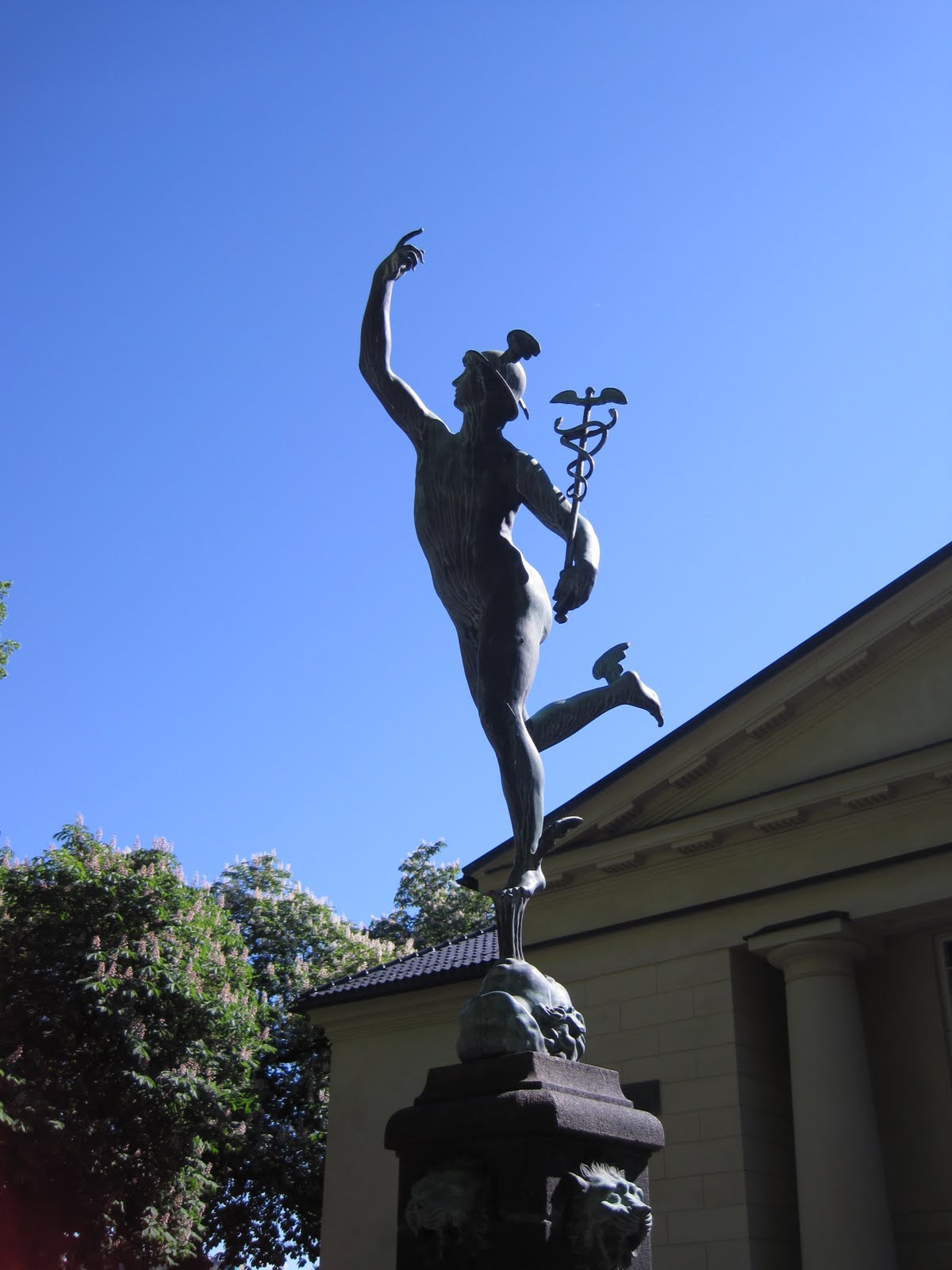
Symbols of Oslo pt. 2: Hermes

Time for part two of my exploration of obscure symbols on Oslo's buildings. One might expect to find the previously covered symbol, the Swastika, it has atleast a tenuous link to Norwegian culture and history - in addition to its universal appeal and geometrical structure. If I were to say that one of the most absolutely most common ornamentations in Oslo depicts the greek god of communication, magic, economy and theft, you might be puzzled. However it is true. Hermes and his caduceus staff can be seen on so many buildings in Oslo it would be an impossible task to cover them all in this blog.

As mentioned, Hermes was the god of communication, theft, magic and commerce, of which the latter is the most important reason we find his countenance on buildings all over the world. As a god of commerce he is an excellent symbol for the stock exchange, and he is indeed placed on a pidestal outside Oslo Stock Exchange, pointing upwards for eternal growth. It's very common depiction of Hermes. Why he is firmly placed on a breath of air emerging from someone's decapitated head is beyond me. Admittedly I'm not as well versed in Greek myth as I'd like to be. If anyone has a clue, let me know. There is another Hermes on the other side of the building, and it's also worth a mention, though I couldn't be bothered including a picture of it here.

As a god of commerce he also adorns Christiania Glasmagasin, one of the most well know and early department stores in Norway. Christiania Glasmagasin, despite its name and upper class appeal is a shopping mall, and I doubt many of the people who do their shopping there notice Hermes above the door main entrance where he looks absentmindedly across the street where Christian IV points decisively at the ground. If I had to rest above the entrance to a shopping mall I'd probably want to avert my gaze from the vulgarians below me too. It's a really beautiful bust though. (There is such as thing as an unattractive bust dear reader...)

OK, so shopping malls I can understand. In the provincial village Trondheim there is even a mall named after him: Mercursenteret. Mercury of course being the roman name for Hermes. The next one is a mystery though. Smuget is a restaurant/bar/stage in Oslo well known for its stand up shows and various events, and for some reason they have a huge full statue of Hermes resting above the main gate, next to Poseidon. I have no idea what they're doing there, and it's not like they're subtle in any way. I can only guess whatever institution was there before Smuget had some link to commerce and shipping, but I don't know. Not gonna be bothered trying to find out either. It certainly is one of my favorite depictions of him however.

This leads to the next one, which is just a block or two away from the stock exchange. It's a more subtle ornament than the former three, and I have no idea what it's doing on that particular building - which houses a military academy. Hermes was a god of many things, but invasion, murder and anguish were not among his attributes. The building is located in an area of the with quite a bit of history, and it's not unlikely that there was some kind of trade house or something there at some point. After Oslo burned in 1624 the town was moved here by the danish king and renamed Christiania in honor of himself (this is also the reason for the aforementioned statuary pointing to the ground). In every other respect it's a rather unassuming building, but any building with a Hermes on it is close to my heart.

Not far from this one there is another one, in Fred Olsens gate. It's a more modern depiction, but I don't know how new, could look like the twenties or thirties judging by style. I would guess Art Noveau anyway, I'm not an expert. This one was brought to my attention by a friend of mine who also has interests in the world of occultism. I don't have much to say about this one,except that it's really nice, and that it's just one of many really cool ornaments on this particular building. Some of them even look overtly occult. Such as the child holding a winged globe just to the left of the Hermes. Incidentally the bulding also houses an outlet of the scammers in UFF, where you should never spend money if have any form of conscience whatsoever. And, yes, the sun was out the day I took the picture, and my camera isn't exactly state of the art. That shadow annoyed the hell out of me.

Now for the caduceus, the snake staff Hermes often carries. For some reason it has become a symbol of pharmacies and medicine, and can often be seen on medical buildings, such as hospitals and drug stores. Most likely this is due to a misinterpretation of the symbol as a variation of the other snake staff, the rod of Asclepius, which is actually relevant to the medical profession as opposed to the caduceus. I'm not going to say much about this quite common symbol, because a list of pharmacies would be tedious - and would further this rather strange misapproproation. The Caduceus is not just a symbol for Hermes of course, but it's probably been more associated with him than the other greek gods over the years, and I don't think it's an oversight to say that in most cases (except of course in the medical ones) it's safe to assume that the staff represents Hermes. This first one is located just across the street, more or less, from the military academy and housese Datatilsynet, a public institution responsible for monitoring the use of surveillance and data storage and so forth. So the Hermes reference is certainly apt, though I do suspect that this building is much older than the institution it houses.

A case where the caduceus is clearly linked to Hermes is on the aforementioned Christiania Glasmagasin, where there are in fact several of them. They're not very big, but you can clearly make them out near the western entrance. Neither is it as conspicuous, but there is certainly no doubt as to what it is.

So anyway, that's it for Hermes. I'm sure you should be able to spot a few of these on your own, and I haven't covered all the ones in Oslo either. They are quite numerous, and if you live in a city of reasonable size, and with a little history I'll bet money there's atleast one Hermes there. Keep your eyes peeled and your camera charged.

20100606

The Swastika

Considering that I have recently posted two blogs about the swastika, more or less directly, I think it would be appropriate to post something about the symbol itself. Origins, meanings and so forth. As a symbol nerd, I have something of an obsession with this dangerous and alluring piece of graphic.

As mentioned in the blog about Thule the national socialists operated on the assumption of cultural dissemination. That is to say, in this context, the swastika had a singular origin, and was spread to the rest of the world via contact or colonisation. They saw this is parallelling the spread of architectural features like pyramids.

And, yes, you can find pyramids (or similar shapes) as well as swastikas around the world, but the assumption that this a result of contact is ungrounded. You can find pyramid, or similar, shapes in cultures as distinct as the Aztec, Greek, ancient Egyptian, Babylonian and even during the Japanese Kofun period. The fact is you can find burial mounds in every part of the world, and the evolution of smaller mounds into larger more elaborate mounds is well documented. This form of burial is also linked to cultures with a high level of centralized religion and strong state authority. So the pyramids don't tell us about ancient contact, but about social structures.

Likewise with the swastika. If you study the graphics of the swastika with an evolutionary mind you can see that it's a very simple symbol. Imagine yourself in the bronze age - with a creative mind and no written language to express yourself with. You need to develop a set of pictograms detailing the world around you. There is a natural progression of expression. The simplest form of graphic is a dot. The next level would be a line. In order to progress from there, and make the line more complex, you can either bend it into an angle, or make two of them. If you really want to get advanced you can combine them into a cross shape.

The swastika is a natural progression from there, and you can choose to intpret it as either four angles put together, or a cross with angles on it. You could even say it's a prototype for the more advanced cross enlosed by a circle. Either way it's a very natural early pictogram. It is both remarkably complex and incredibly simple. But still not simple enough that low brow skinheads manage to get it right all the time. How many times have I seen a swastika sprayed on a wall, where one of the angles point the wrong way or with similarily inane failures? Too many to count... And you wonder why neo nazism seems to attrack drop outs?

If you would want to play the devil's advocate for the idea that these cultures must've been in contact with each other you would say something like "Yeah, sure, simple, but all the cultures used the swastika as a symbol of the sun. How can that be?" And yes, this might be true. We can only make guesses about the meaning of early symbols, but let us work under the assumption that they are all in fact sun symbols (while sometimes this meaning has certainly been further evolved into different levels). This certainly seems to be the general consensus.

It is generally assumed that language evolved beyond the level of grunts and ughs as humans gained access to abundant sources of food. The reasoning is that when humans had time to relax and think about other things than running around trying to stab animals to death or wonder where there was some good fruit, they started thinking about abstract things. What are the stars and the moon, and the sun? How are the heavenly bodies linked to my life? What is the meaning of all this? And so forth. This led to cave paintings and early symbols as a form of cultic expression. Later when the agricultural revolution paved the way for urbanization and more complex socities with organized religion and trade the need for more complex pictograms also arose. And in fact the oldest occurences of swastikas we know of were found in the Mohenjo Daro region, where the oldest city culture also arose.

While spoken language is about direct communication written language is in fact primarily a storage medium. Even long before the portable USB stick humans found that they needed to convey and store communication across distance and time. Numerous theories highlight the link between trade and math or the alphabet, but this is supposed to be about the swastika and the sun. The agricultural revolution brought about two very important changes that are relevant to this topic: sun worship and pictographic writing. It is easy to surmise that one of the earliest symbols one would need to express would be the sun itself. And in all the various early cultures we see the sun symbolised by very "primitive" symbols. The swastika, a cross in a circle, a circle with a dot in the center, and so forth. Written language was created to convey abstract ideas rather than everyday gossip, and the most important abstract ideas around would be numbers (lines and dots) and the sun (evidently one step higher in terms of complexity). The fact that the swastikas arms seem to depict a form of motion could also be seen as symbolizing the sun's link to the four seasons of the year.

So at the same time people around the world started to get the idea that there was a link between the sun and the growth cycles of their crops, they also started developing pictograms. This does not mean that they were in touch with each other from the get go, even though cities also came with trade routes and cultural contact. Still, at times you do come across theories of dissemination in modern publications and with differing levels of credibility or evidence. I have heard that some archaelogists claim that early northern religion was inspired by phoenician traders, based on the fact that the earliest stone carvings in sweden depict a type of ship that was common in the mediterranean, but has never existed in Scandinavia, and the motif of twin gods - also common in that particular area. On the othern end of the scale you have Thor Heyerdahl with his ideas that polynesia was settled from south america - based on similar observations. He has of course been proven wrong by genetics, but maintained his ideas as long as he lived. If you go even further out you find Von Dänicken and his chariots of the gods. Wildly ammusing to read, and so very very preposterous. Still, modern theories of contact have long since abandoned the idea that culture arose in a single area, and the spread. For some reason however many linguists seem to be lagging behind and are still working under outdated assumptions about a first language, on which all later languages are based.

With time the swastika became a common symbol in some parts of the world, primarily asia, while it was replaced by other symbols in other parts of the world. Specifically the christian cross became the primary symbol of divinity in the western hemisphere, and the swastika disappeared from use (even though a tenuous link exists in the so called celtic cross or sun cross, whish is also a pre christian solar symbol similar to the swastika in many ways, with the angles replaced by a circle). When the swastika resurfaced centuries later, it was under the sanskrit name and in some cases links to european paganism and a strong political content. In other cases it was used simply because of its qualities as a good luck charm in asia or in architecture, and as such it was quite popular until this meaning was overtaken by the more well known polical use.

And we all know the end of the story, in the western hemisphere. The swastika has been so strongly linked to genocide that it is nearly impossible to use it in any other context. Despite groups like "reclaim the swastika" and numerous organizations using it because of its pre-christian meaning. Even non western religious groups find that symbol's controversial links are hard to swallow for Europeans. You can imagine what happened when the Raëlians tried to establish themselves in Israel. Their logo is none other than a star of david intertwined with a swastika - as pictured. Things are slowly improving however, and once again it is becoming possible to have an interest in pagan symbolism and myth, without being accused of nazi sympathies. This is a development I personally welcome. I do however disagree with the rhetorics that claim that the Swastika was stolen by Hitler. You can't steal a symbol, it's there for everyone, and we all have equal rights to use them. No single entity can claim ownership of the swastika, not nazis, not paganists, and not hindus - not even Coca Cola. Use it to your own advantage, and as you see fit. It's not a corporate logo, and it's not copyrighted. With this in mind I leave you with this picture I took at bronseplassen in Lillesand, Norway a couple of years ago. They seem to have the idea.